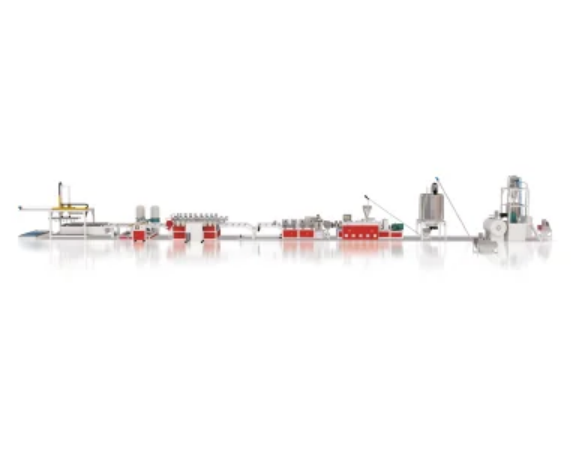
In the thermal management of a PVC foam board production line, the cooling strategy is the primary factor in determining the board’s surface hardness and internal cell structure. When processing cellular PVC, which involves an exothermic foaming reaction, the equipment must rapidly remove heat to “freeze” the foam at the precise moment of expansion. B2B manufacturers must choose between direct and indirect cooling methods to optimize the production of boards ranging from 3mm to 30mm in thickness.
The Physics of Heat Extraction
Direct cooling involves the application of the cooling medium—typically water or air—directly onto the surface of the extruded board or the internal screw shafts. In a PVC foam board extrusion line, direct water cooling in the calibration units provides the highest heat transfer coefficient. This rapid quenching is essential for creating a “skin” on the foam board, which enhances its screw-holding power and resistance to impact.
Indirect cooling, conversely, relies on heat conduction through a secondary medium, such as the metal walls of the extruder barrel or the internal oil-cooling channels of the screws. This method is used to maintain a stable melt temperature during the plasticization phase. While indirect cooling has a lower heat transfer rate than direct methods, it offers superior control over temperature gradients, preventing the “thermal shock” that can lead to warping or internal stresses in high-density boards (0.4–0.8g/cm³).
Precision Thermal Engineering by Boyu
For industrial facilities where consistency is the key to profitability, the integration of these cooling methods is a core design feature. Boyu engineers their PVC foam board production line with a sophisticated multi-zone cooling architecture. Their systems, such as the SJSZ-92/188, utilize high-efficiency oil cooling for the internal screw cores to manage shear heat indirectly.
By using high-precision Omron temperature controllers, they ensure that the transition between these cooling phases is seamless. This technical balance allows their B2B partners to maintain a high-speed output of up to 800kg/h while ensuring the final product meets the rigid flat-surface standards required for furniture and construction applications. Through these robust mechanical designs, they provide a reliable, long-term solution for world-class PVC foam board manufacturing.
