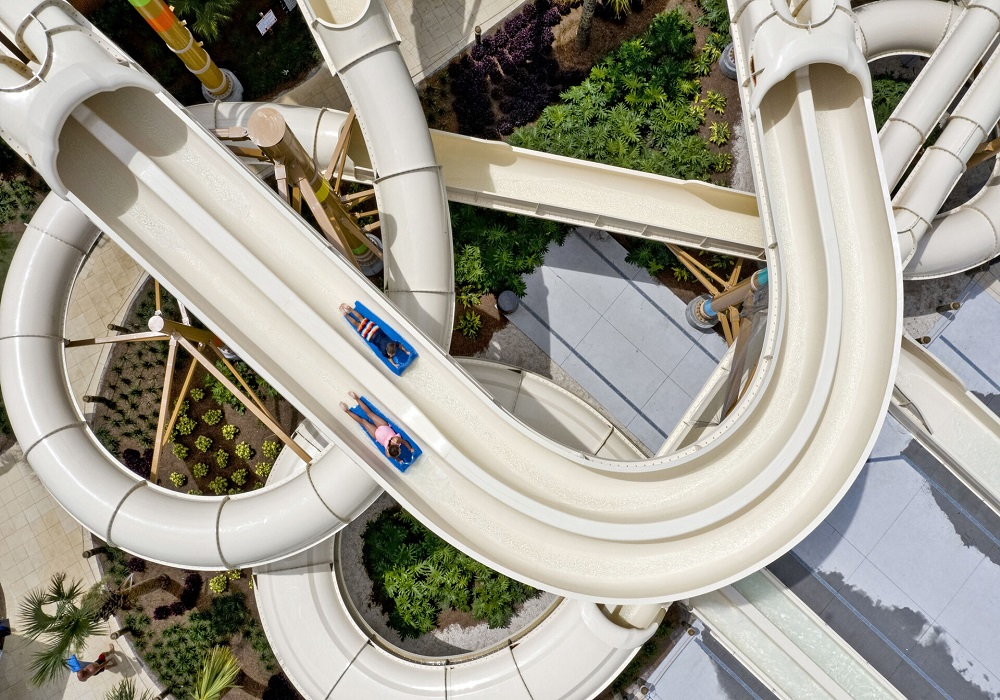
The ride with the longest queue is not necessarily the ride with the strongest demand. Waiting time also reflects loading and dispatch. Investors assessing crowd appeal need to understand who chooses an attraction and what makes that experience worth adding to the venue.
Investors comparing water park slides need to separate three questions: what might attract their audience, how many riders a configuration can accommodate and what running it involves. No verified attendance ranking makes one category the winner for every venue.
Distinguish Interest from Queue Length
A race gives companions a visible contest, while a shared raft lets them experience the movement together. A single-person ride creates another kind of participation. Each format can have appeal, but the reason for choosing it needs to be connected to the intended visitors.
Across the types of water slides, preparation and dispatch also affect the queue. A ride requiring raft collection introduces a task before boarding. Observing that task separately from the descent can reveal whether a waiting crowd reflects the attraction’s appeal, the service process or both.
The existing offer matters here. A park already serving confident individual riders may gain a different proposition from shared participation. Conversely, another raft attraction may repeat an experience already well represented. The relevant comparison starts with the experience missing from the current programme.
Jinchao’s Super Bowl changes the sequence: an initial descent leads into a circular chamber, followed by a central exit, a buffer transition and a splash-pool finish. The choice can therefore concern movement through several stages rather than the maximum number riding together.
Compare Experience, Cost Drivers and Setting
Jinchao’s Tornado accommodates four riders, while its range also includes individual formats, parallel racing and two-person rafts. The comparison below describes practical cost drivers rather than quoted prices. Actual equipment and site-work costs depend on the selected configuration and scope.
| Format | Experience | Cost consideration | Suitable setting |
| Body ride | Individual descent | No inflatable-tube return task | A line-up seeking individual participation |
| Shared raft | Companions ride together | Collection, storage and return arrangements | A park adding a shared experience |
| Parallel racing | Separate lanes with side-by-side competition | Coordinated loading and any mat handling | An audience seeking a group contest |
| Bowl format | Descent followed by circular movement | Specified route and landing arrangement | A line-up seeking a different movement sequence |
The table compares water park slides by the work accompanying the experience. It does not place every body ride below every raft attraction in price. Investors can contact Jinchao about a defined shortlist with the surrounding works identified, so the quotations address equivalent purchase boundaries.
Equipment price and handling costs also belong to different parts of the comparison. A scheme can identify the items bought for installation, then separately describe the daily work of collecting, storing and returning ride equipment. Those entries need the same operating schedule.
Compare Published Rider Figures on Their Own Terms
Hourly figures address a different question. Jinchao lists approximate capacities of 300–400 riders per hour for Twin Racing and 200–300 for Twist Turn. These figures belong to the named models, not to all racing attractions or all shared-raft rides.
The parallel undulating lanes in Twin Racing follow its spiral and dark tunnel sections, with riders travelling individually on mats. Twist Turn instead uses a two-person raft with an opposing-slope sequence. The types of water slides therefore differ in movement and grouping even before their published hourly figures are compared.
A dramatic start creates a further choice. Jinchao’s Flying Fish uses an operator-triggered chamber drop for one rider per lane, with an approximate capacity of 200–300 riders per hour. Its individual format differs from sharing a raft despite the similar hourly range.
A published hourly figure leaves the demand question open. Operating arrangements for boarding, dispatch and exit clearance can also change what is achieved. Forecasting crowd movement combines the number choosing a ride with its planned operating arrangements.
A capacity enquiry can identify the proposed model when operators contact Jinchao. It can also describe the intended staffing and equipment-return arrangement. That gives the discussion an operating context while preserving the approximate nature of the published figures and the conditions of the proposed installation.
Choose the Attraction the Park Can Support
Before selecting water park slides, the investor can put each candidate through the same commercial review: intended riders, added experience, site requirements and daily work. A desirable ride still needs a place within the available height, landing arrangement and staff responsibilities.
The types of water slides sit within Jinchao’s wider design and production offering. Its approximately 36,000 m² manufacturing base and experience across more than 300 projects describe company scale. The preferred ride still needs a specific configuration and operating assessment based on the intended visitor group.
The decision can be carried into design when project teams contact Jinchao with their preferred experience and site information. Its custom-design service can address the resulting equipment arrangement. Questions about storage, access and staff work remain attached to the attraction being considered.
Shared riding merits attention where companions lack an attraction to experience together, and racing merits attention where competition would add contrast. An individual format remains relevant where that is the missing offer. The selection rests on a stated audience need, a comparable cost scope and an operating plan for the chosen format.
