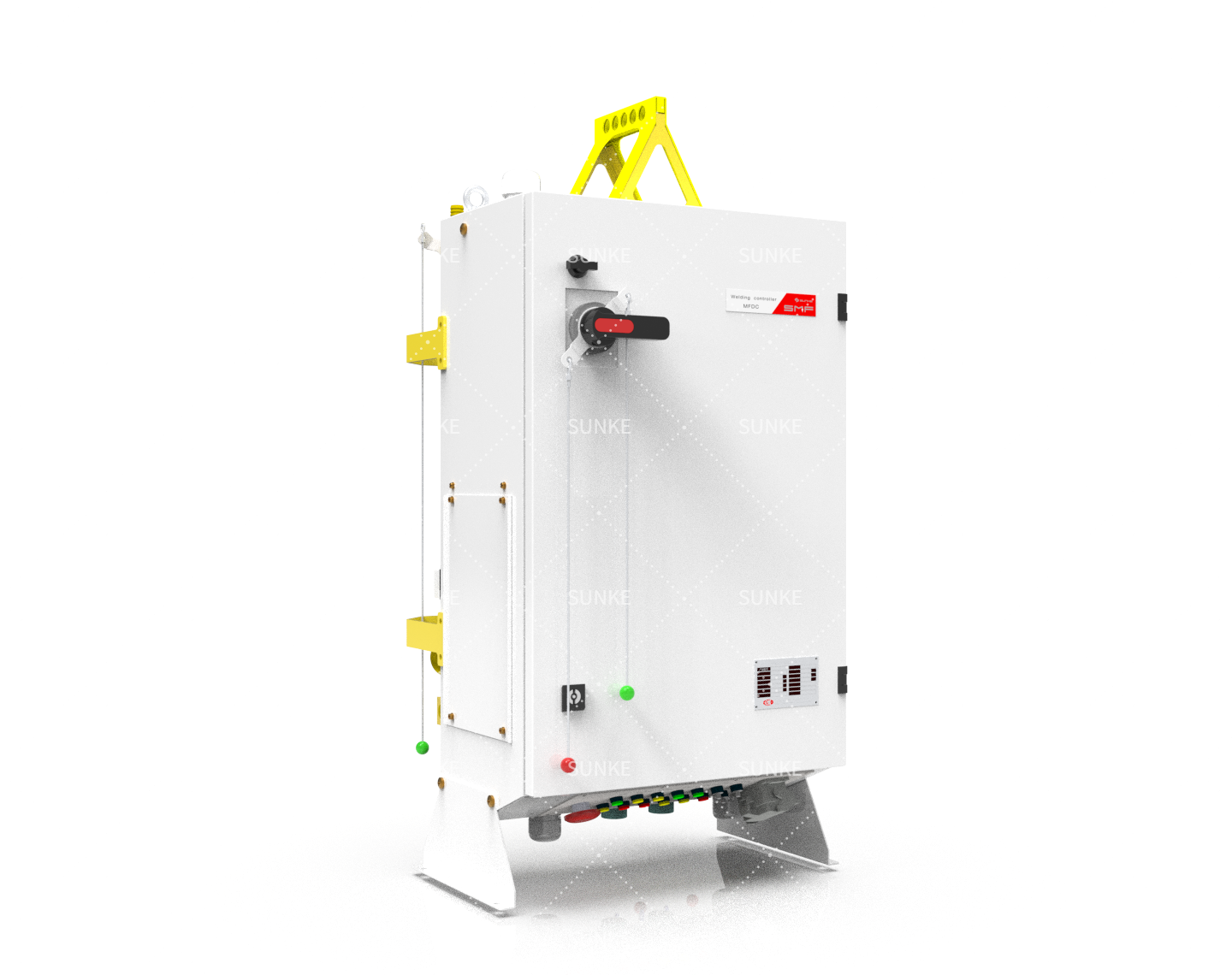
Reliable metal joints depend on more than electrode pressure and contact time. The electrical energy delivered during each weld determines how heat develops, how the materials respond, and whether the joint meets production requirements.
A welding power supply provides the controlled electrical energy needed for this process, but its performance also depends on the control strategy, workpiece characteristics, and equipment configuration. Understanding these factors helps engineers diagnose inconsistent welds and select equipment suited to their manufacturing processes.
How Electrical Energy Becomes a Weld
Resistance welding generates heat as electrical current passes through materials and their contact interfaces. The process is commonly explained through Joule’s law: heat depends on current squared, electrical resistance, and the duration of current flow. Even small changes in any of these variables can influence weld formation, making accurate electrical control essential.
Unlike processes that rely on an external flame or arc, resistance welding concentrates heat within the workpiece and its contact area. Electrode force maintains contact and helps manage the interface while current flows. If current is too low, the joint may lack sufficient fusion; excessive current can cause expulsion, surface damage, or electrode wear.
The role of a welding power supply extends beyond delivering electricity. Its output characteristics must match the material thickness, alloy, joint geometry, and required production rate. Engineers also need to consider the operating cycle and the repeatability of current delivery, particularly when hundreds or thousands of joints are produced within a single shift.
Why MFDC Technology Matters in Manufacturing
Medium-frequency direct-current technology converts incoming alternating current into a controlled DC welding output. Compared with conventional line-frequency AC systems, MFDC equipment can provide a more consistent current profile and support precise adjustment of welding parameters. These characteristics make the technology useful in applications where joint quality and cycle repeatability are important.
MFDC is one of several technologies used in resistance welding systems. For a broader technical perspective, this MFDC, MFAC, and capacitor discharge welding controller comparison explains how their operating principles and application requirements differ.
An MFDC resistance welding controller manages the welding sequence and regulates current according to configured parameters. Depending on the system, it can support primary- or secondary-current control, helping compensate for variations that affect the electrical circuit. Communication interfaces may also connect the controller to factory automation systems for parameter management and process monitoring.
The appropriate configuration depends on the application rather than the technology label alone. Automotive assemblies may require repeatable spot welds across coated or high-strength steels, while electronics manufacturing can involve small components with narrow process windows. Battery-related production introduces additional concerns about conductive materials, heat-sensitive parts, and the consequences of inconsistent joints. Each application calls for a validated combination of current, time, force, and electrode geometry.
Choosing Control Features for Stable Production
A capable resistance welding controller should offer adjustment options that align with the process requirements. Current regulation, programmable weld schedules, sequence control, and fault detection can help operators maintain consistent production. Where several materials or joint types share a workstation, recipe management can reduce setup errors and make parameter changes easier to track.
Cooling and integration requirements deserve attention during equipment evaluation. Air-cooled and water-cooled configurations suit different thermal loads and operating environments. Communication compatibility is equally important: the controller may need to exchange status signals and process data with a programmable logic controller, robot, or plant monitoring system. Compatibility should be confirmed against the actual automation architecture rather than assumed from a general product description.
A practical welding power supply assessment should also consider serviceability and the quality of process information available to engineers. Useful diagnostic records can help distinguish electrical faults from problems involving worn electrodes, inconsistent clamping, surface contamination, or incorrect part positioning. Before purchase, manufacturing teams should verify output capacity, duty cycle, available control modes, cooling requirements, and interface support against realistic production conditions.
Applying MFDC Control to Real Production Needs
In an industrial setup, the controller and the power source operate as parts of a wider welding system. The electrodes, transformer, mechanical fixture, and control logic all influence the final result. A technically capable electrical unit cannot compensate indefinitely for poor electrode alignment or unstable clamping, so process development must examine the entire welding station.
Sunke’s MFDC welding controllers are designed for manual and automated resistance welding applications, including spot, projection, and seam welding. The available configurations support primary- and secondary-current control, with air- or water-cooling options depending on system requirements. For production teams evaluating a resistance welding controller, key considerations include the required current range, welding schedule, equipment compatibility, and available communication interfaces.
Process validation should precede full-scale production. Engineers can begin with representative workpieces, establish a suitable welding schedule, and inspect joints through appropriate destructive or nondestructive tests. Monitoring current, time, electrode force, and visible signs of expulsion helps identify the process window. After parameters are approved, periodic checks and electrode maintenance help preserve consistency as operating conditions change.
Conclusion
Electrical control is only one part of dependable resistance welding, yet it strongly affects how repeatably a joint can be produced. A well-matched welding power supply, supported by a suitable resistance welding controller, gives production teams greater control over heat input and welding sequences.
By evaluating material requirements, machine integration, diagnostic capability, and test results together, manufacturers can make equipment decisions based on measurable process needs. Sunke provides MFDC control options for industrial welding environments where stable operation and practical integration are central considerations.
