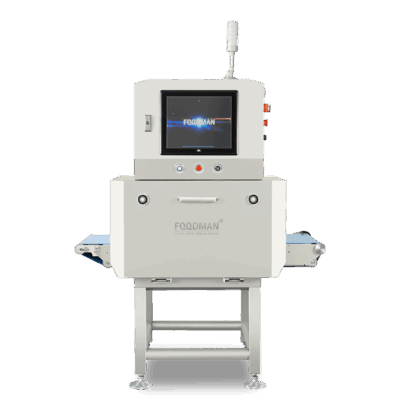
Food manufacturers need to identify foreign objects that may remain hidden inside a product, package, or dense food mass. Visual checks cannot see through packaging, while conventional metal detection has a narrower detection range. X-ray food inspection addresses this gap by examining differences in material density inside products. Modern systems can inspect packaged and unpackaged foods while supporting automated foreign-object detection on production lines.
How Does X-Ray Inspection See Inside Food?
The basic principle is penetration. An X-ray source sends radiation through the product as it moves through the inspection area. Materials absorb X-rays differently according to their density and composition. The detector captures these variations and converts them into an image that the inspection system can analyze.
Dense foreign objects generally create a stronger contrast against the surrounding food. Software can then identify suspicious areas and trigger a rejection or alarm when the product does not meet the configured inspection criteria. This makes the technology fundamentally different from visual inspection, which primarily evaluates what cameras can see on the product surface.
The process is automated and can operate continuously as products move along a conveyor. Depending on the system configuration, image processing and intelligent algorithms can support foreign-object recognition and improve inspection efficiency. Foodman Vision, for example, describes X-ray systems designed for efficient foreign-object detection across food and packaged products.
What Can an X-Ray System Detect That Surface Inspection Cannot?
The main value of X-ray inspection comes from detecting contaminants that may be concealed by food or packaging. Foodman identifies examples including metal, glass, bones, ceramics, stones, sand, rigid plastics, and other foreign materials across its inspection solutions.
That detection range matters in products where contamination can become embedded during processing. A bone fragment may remain inside meat, a glass particle can be hidden within a packaged food, and a stone may be difficult to distinguish from a dense food ingredient by appearance alone.
The technology also provides an alternative when contamination is not limited to ferrous metal. A metal detector is designed specifically around metal detection, whereas X-ray systems can identify a broader range of high-density foreign objects. Foodman states that its X-ray systems can detect both metallic and non-metallic contaminants.
Detection capability still depends on the product, contaminant, packaging, and machine configuration. Therefore, the presence of X-ray technology does not mean every foreign object will be detected at an identical sensitivity under every production condition.
Where Does X-Ray Inspection Fit on a Food Production Line?
Placement depends on how the food is handled. Packaged products can pass through an inspection system after filling and sealing, allowing manufacturers to examine the finished package without opening it. Foodman offers systems specifically designed for small, medium, and large packaged products.
Bulk products require a different approach. Loose materials such as rice, wheat, nuts, grains, coffee, and other unpackaged products can be inspected before they reach a later processing or packaging stage. Dedicated bulk systems are designed around these material flows rather than sealed packages.
The same principle extends across different food categories. Current Foodman applications include snacks, meat and poultry, beverages, bulk foods, seafood, fruits and vegetables, cheese, and dairy products.
This flexibility is important because food plants rarely handle only one type of product or one package format. Inspection equipment therefore needs to match the physical characteristics of the production line rather than simply being selected by product name.
Why Packaging Does Not Have to Be Removed for Inspection
One of the practical advantages of X-ray inspection is that products can often be inspected after packaging. The X-rays penetrate the package and allow the system to analyze the contents. This is particularly useful for sealed foods because opening each package for inspection would destroy the product and make continuous quality control impractical.
Packaged applications can include products such as cheese, biscuits, chips, seasonings, meat products, poultry, fish products, coffee, and solid drinks. Foodman lists these product categories for its packaged-product X-ray systems.
For manufacturers, the result is a non-destructive inspection stage that can be integrated into an existing production workflow. Products that fail the configured inspection criteria can be automatically rejected, helping prevent suspected contamination from continuing toward shipment.
What Determines Whether X-Ray Inspection Is Suitable?
Choosing an X-ray system requires more than identifying the food category. Product density, package dimensions, package material, production speed, contaminant type, and inspection position can all influence the appropriate configuration.
Packaging format is one of the first variables. A sealed pouch, bottle, carton, or loose bulk product creates different inspection conditions. Product size also matters because larger or denser products may require a system designed for deeper penetration.
The target contaminant should be considered at the same time. A manufacturer concerned about bones, glass, stones, metal, or rigid plastic may require a different inspection strategy from a producer focused mainly on metallic fragments.
Foodman’s product range separates solutions for packaged products, bulk materials, canned products, bones, pumped products, and fat analysis, illustrating why inspection equipment is normally configured around a specific production scenario rather than treated as a universal machine.
Matching Inspection Technology to the Production Problem
At its core, X-ray food inspection is a method for examining the internal condition of food without relying solely on surface visibility. Its value comes from combining X-ray penetration, image analysis, and automated inspection with the actual requirements of a production line.
For manufacturers evaluating X-ray food inspection, the right question is therefore not simply whether X-ray technology can detect foreign objects. The more useful question is whether the selected system is matched to the product, packaging, contaminant, and production workflow. Foodman supports this decision-oriented approach by treating inspection as part of the wider automated production process rather than as an isolated detection step.
When those variables are correctly matched, X-ray inspection can provide a practical layer of internal foreign-object control for packaged and bulk food operations. Foodman can also be considered when manufacturers need an inspection solution aligned with their specific production requirements.
