A household’s ordinary routine and an imagined seasonal gathering can place different demands on its storage. In this hypothetical household, frozen-storage needs dominate the usual allocation, but the seasonal period brings a larger chilled-storage requirement.
The change concerns the balance between uses, even if the available appliances remain the same. Examining freezer vs refrigerator choices through this timeline explains what conversion could change: the purpose assigned to one cabinet, alongside the accommodation still needed for contents requiring the other condition.
Demand Shifts Across Two Periods
The difference between the ordinary period and the seasonal peak makes timing part of the storage problem. The household normally assigns substantial space to frozen contents and less to chilled contents.
During the imagined gathering period, that balance shifts toward chilled storage. These descriptions illustrate changing priorities, without supplying actual household measurements. The planning question concerns how the existing allocation relates to each period’s demands.
A single snapshot of a crowded cabinet would conceal the reason for the pressure. The seasonal chilled requirement might represent a temporary departure from the usual balance rather than a permanent change in the household’s routine.
Describing both periods keeps that distinction visible. A freezer vs refrigerator comparison then concerns allocation over time, with the ordinary arrangement and the temporary priority considered within the same storage setting.
Demand for the less prominent function remains part of the account. A rise in chilled-storage needs does not make the frozen contents cease to require frozen storage.
The household’s hypothetical seasonal allocation therefore includes both the priority that has grown and the requirement that continues. This prevents the seasonal peak from being described as if all contents had acquired the same need. The imbalance has changed; the two uses still require accommodation.
One Cabinet, Different Assigned Uses
Full-cabinet conversion changes the use assigned to an existing volume. In contrast, fixed compartments allocate their space to separate functions within an arrangement that retains those roles.
A selectable full-cabinet mode provides another kind of allocation: the cabinet serves the chosen function for the period under consideration. Its purpose changes without multiplying its volume. This is the distinction that makes the hypothetical household’s timeline relevant to a convertible model.
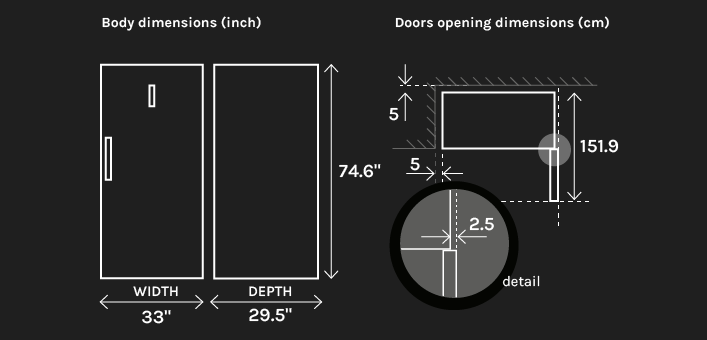
The FN1-77 provides a named example in the comparison published by Homa Appliances. The FN1-77 offers 603 liters of total net capacity, electronic temperature control, No Frost cooling, and selectable refrigerator or freezer operation. These are the model details supporting the allocation example. The stated capacity describes one cabinet; it is not two complete capacities available concurrently.
In the illustrative seasonal plan, a cabinet previously allocated to frozen storage could be assigned to chilled storage if the selected model supports that use. The available volume would then serve the increased chilled requirement.
A freezer vs refrigerator comparison must describe the volume in its chosen mode. Counting it again as available frozen capacity would conceal the consequence of the reassignment. The former use needs accommodation elsewhere during that period.
Electronic temperature control and No Frost are feature names in the model description, not a schedule for carrying out a change of use. They do not establish a switching duration, an automatic response to seasonal demand or a particular energy result.
Their presence can be recorded without assigning those outcomes. The allocation explanation rests on the full-cabinet alternatives described for the model, with practical changeover details left to its instructions.
The Contents Outside the New Priority
Contents still requiring frozen storage expose the constraint in the seasonal chilled-storage plan. The reassigned cabinet can no longer be counted as their accommodation while it serves the chosen chilled function.
Suitable space elsewhere must therefore be identified for that continuing requirement. The same reasoning works in reverse if a later priority favours frozen storage. Reassignment creates a displaced storage task that belongs within the plan.
An alternative location needs both appropriate use and enough room for the displaced contents. Merely identifying an empty cabinet repeats the mistake of counting space without its function. A freezer vs refrigerator plan can compare the continuing requirement with the proposed alternative before treating reassignment as workable.
A proposed destination can be named beside each displaced group, making the remaining storage allocation visible. This check concerns the contents’ destination, while the selected convertible model’s instructions govern how a permitted change of mode is carried out.
The full-cabinet alternatives described by Homa Appliances give the planning exercise its model-specific basis. They do not establish that every freezer can be reassigned or that the example household already owns a suitable appliance.
Confirmation of the selected model’s modes and changeover instructions remains necessary. Once those are known, the timeline can connect the intended new use with the arrangement for contents displaced from the cabinet’s previous role.
Unplaced contents requiring the other storage condition keep a conversion proposal incomplete, even when the new mode suits the seasonal priority. The household’s allocation must account for the task gained by the converted cabinet and the task moved elsewhere. A subsequent return to ordinary use would also require that relationship to be reconsidered. The changing demand can be met through the chosen mode only if the remaining contents also have an appropriate storage destination.
